
The Valuation Penalty of Disjointed Narratives: A Small-Cap Guide to Modern Investor Communications

When a micro or small-cap company struggles to gain market traction, it is easy to assume you simply have an investor relations problem. However, if you take a closer look at how information actually moves through today's capital markets, the roadblock is often hidden deeper, in narrative structure and digital infrastructure. It is no longer enough to release data into the wild and hope the street finds it. Sophisticated capital simply doesn't work that way anymore.
If your company's core milestones are inadvertently buried inside jargon-heavy, 60-page PDF slide decks or trapped in static press releases, you might be paying an invisible valuation penalty. Modern investors demand immediate clarity, and the digital ecosystem requires absolute discoverability. When an AI financial aggregator or a busy analyst can't easily parse your milestones due to a disjointed digital footprint, your story can quickly become invisible to the market.
To build long-term shareholder retention on exchanges like the TSXV, CSE, NASDAQ, or OTC Markets, the goal is to look past traditional IR outreach and ensure your company is fundamentally structured for how modern investors actually research.
1. The Death of the PDF: Digital Discoverability as an IR Mandate
Many small-cap leaders believe their job ends once a press release crosses the wire or a filing hits SEDAR+ or EDGAR. That is a dangerous mistake.
The modern investor's research process has fundamentally changed. Analysts, institutional funds, and retail allocators are no longer manually combing through cluttered investor pages; they are using AI search tools, alpha-aggregators, and semantic search engines to filter opportunities.
If your website content, presentation text, and operational milestones aren't structured to be crawled by these digital channels, your company is locked out of the visibility loop.
The Discoverability Fix: Your digital presence must serve as a highly indexable information hub. This means moving away from dynamic text locked inside heavy graphics or scanned images.
Accessibility Over Complexity: Clean, clear text hierarchies and accessible web infrastructure aren't just for compliance—they ensure your core value proposition is instantly readable by both human eyes and machine-learning scrapers.
2. Stripping the Hype from Content Marketing
There is a common misconception that small-cap investor marketing needs to look like consumer marketing, complete with trendy social media language, empty buzzwords, and a focus on "building a community."
Sophisticated investors do not care about a corporate community; they care about capital allocation, milestone execution, and risk mitigation.
When you frame operational updates with generic marketing fluff, you send a clear signal to the market that your project lacks substance. This is particularly true in highly technical sectors like resource exploration and technology.
Clarity Over Jargon: Your technical data, whether it is drill results, software architecture updates, or clinical phase trials—must be translated into structural milestones.
Explain the "Why": Never publish data for its own sake. Every piece of communication must answer a singular capital-market question: Why does this specific milestone de-risk the project or drive future valuation?
3. The Psychology of Volatility: Leveraging Behavioral Finance
Small-cap stocks are inherently volatile, and executive communications must actively counteract the emotional swings of the market. When communication becomes erratic or silent during market downturns, investors fill the information void with anxiety.
Understanding investor psychology means recognizing that market trust is built during operational quiet periods, not just during high-profile financings or major acquisitions. For a deeper look at managing these psychological triggers, reviewing what behavioral finance teaches CEOs about investor communication provides a foundational blueprint for framing narrative updates during market cycles
The Trap of Over-Promising: The fastest way to permanently damage executive credibility is to over-promise project timelines or conceal technical bottlenecks.
Authenticity in Deficit: True narrative alignment requires addressing operational challenges in real-time. Sophisticated allocators respect a management team that clearly outlines a problem, details the mitigation strategy, and stays accountable to the capital structure.
4. The Shift to AI-Native Modern Investor Communications
Artificial intelligence is actively reshaping small-cap corporate access. From public-facing website assistants to internal predictive analytics, these tools are no longer optional. However, deploying them incorrectly creates unprecedented legal and narrative risk.

Website Assistants and the "Content Gap"
Using document-grounded AI tools on your IR website allows stakeholders to query your historical disclosures using natural language. But the true value for executives lies in the back-end data. These platforms track the exact questions investors are asking, giving management a direct window into your "content gaps", the precise areas where your current presentation materials are failing to provide clarity.
Predictive Targeting vs. The Cold Roadshow
Chasing the wrong funds is the fastest way for a small-cap executive suite to waste time and capital. Modern IR CRMs use predictive data layers to monitor investor behavior and interest signals, allowing you to focus your outreach on institutional buyers whose mandates actually align with your sector and market cap.
5. The Threat of "AI-Washing" and Regulatory Exposure
As public companies rush to adopt and discuss artificial intelligence, securities regulators are cracking down heavily on exaggerated or misleading technology claims.
Whether you are implementing AI tools to streamline your modern investor communications or touting proprietary AI capabilities within your technology stack, cross-border issuers must strictly manage their exposure.
Regulatory Scrutiny: Overstating your technological capabilities or failing to establish rigid disclosure controls can trigger swift enforcement actions from the SEC or under Canadian securities laws (such as those outlined in CSA Staff Notice 11-348).
The Safeguard Checklist: Before any automated system or AI assistant interacts with the public domain on behalf of your company, legal and IR teams must verify that the underlying data is entirely ring-fenced to approved regulatory filings. There must be an absolute human-in-the-loop checkpoint for every piece of market-facing narrative.
The Strategic Reality Check
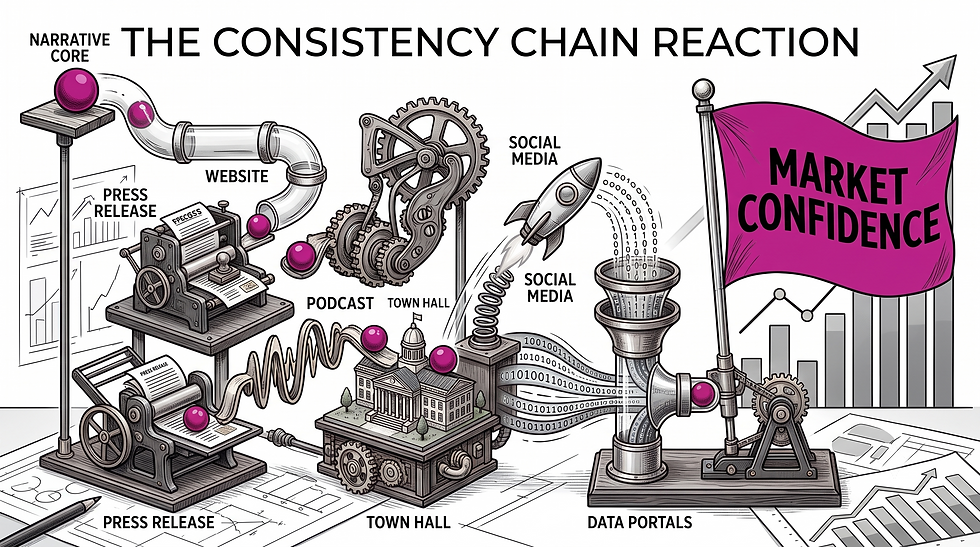
Your capital market authority does not come from marketing hype, sensationalized numbers, or trendy digital tactics. It comes from pattern recognition, operational depth, and absolute structural consistency across every communication channel you own.
In a hyper-fragmented digital landscape, the threat isn't a completely rewritten narrative—it is the subtle erosion caused by information asymmetry. When data points lag on one platform, disclosures are oversimplified on another, or your external IR team isn't perfectly synced with your internal updates, the market notices.
Institutional investors are hyper-tuned to risk. They track the gaps between what you say, where you say it, and how fast you update it. In this environment, seamless cross-channel alignment isn't just an administrative task; it is a direct driver of valuation. Consistency breeds predictability, predictability breeds confidence, and confidence is the only currency that commands a premium.
To learn more about optimizing your digital footprint, improving retail investor visibility, and mastering AI search visibility for small-cap equities, subscribe to the BULLVISION newsletter.
About the Author: Anna Dalaire, Strategic Advisor to Junior Mining and Small-Cap Leaders. Writing about capital markets, investor communication, narrative strategy, and applied AI.
Disclaimer: BULLVISION Consulting Inc. and its authors publish content for informational and educational purposes only. The views expressed are those of the author and are based on experience in capital markets, investor communications, governance, and public company strategy.
This article is not investment advice, financial advice, legal advice, accounting advice, or a recommendation to buy, sell, or hold any security. References to valuation, trading activity, governance structures, or market performance are provided for commentary and educational discussion only.
Any opinions regarding investor behavior, market psychology, valuation, governance, or capital markets are personal observations and should not be relied upon for investment decisions. Readers should conduct their own due diligence and consult qualified professional advisors before making any investment decisions.
While reasonable efforts have been made to reference reliable publicly available information, no representation or warranty is made regarding the accuracy, completeness, or timeliness of the information presented. Markets, valuations, and company-specific circumstances can change rapidly.
BULLVISION Consulting Inc. may provide communications, consulting, or advisory services to public and private companies discussed in future publications. Any material business relationships, where applicable, will be disclosed in connection with specific company commentary.


